
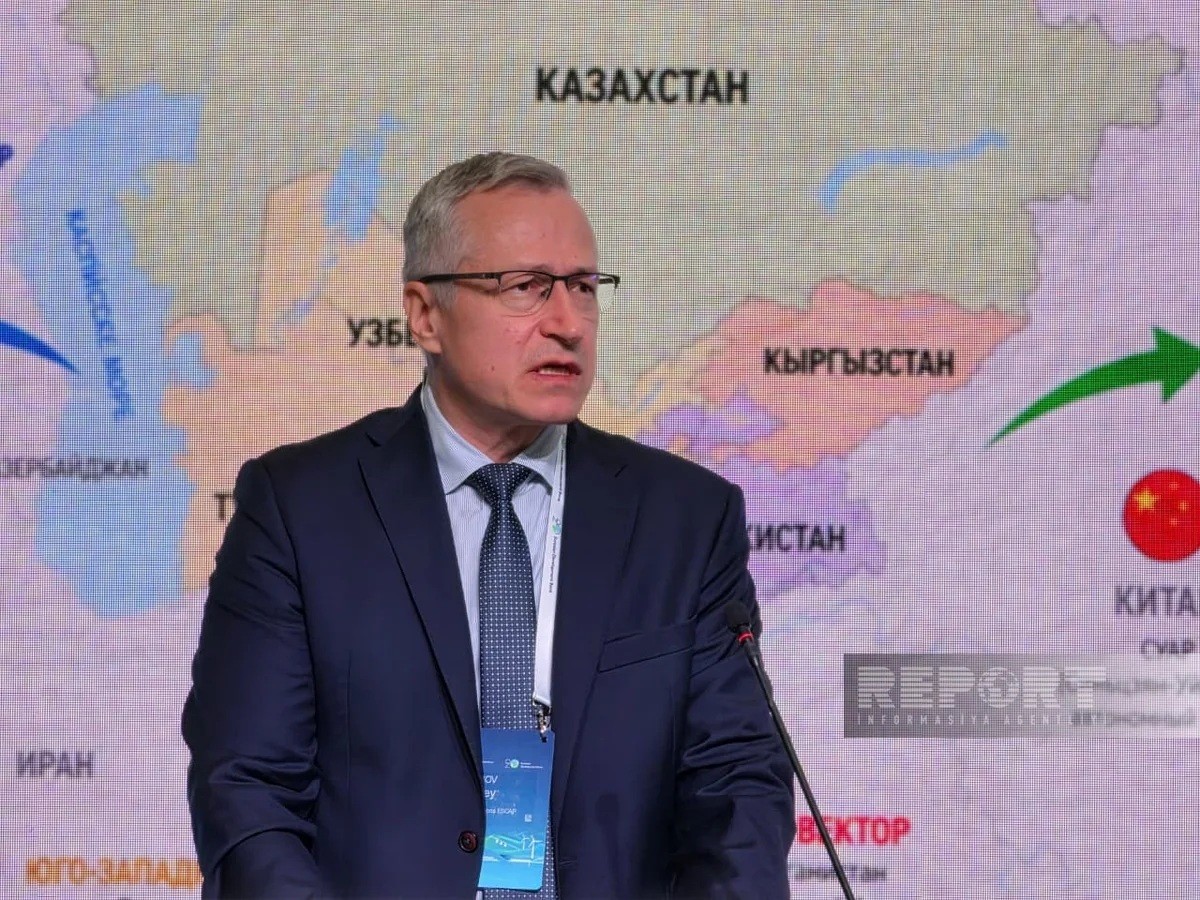
The Trans‑Caspian Green Corridor connecting Central Asia with Azerbaijan could become a long‑term strategic route for exporting surplus electricity generated from renewable energy sources (RES), Report informs from Almaty, citing Sergey Tulinov, Head of Projects at the secretariat of the UN Economic and Social Commission for Asia and the Pacific (ESCAP), speaking at the annual meeting and business forum of the Eurasian Development Bank (EDB).
According to him, the development of RES in Central Asia should be carried out in stages, which will create conditions for gradually expanding regional cooperation opportunities and forming a mutually beneficial electricity market: "The first stage involves improving existing interaction mechanisms. The second relates to the launch of a pilot 'day‑ahead' market, which is actively developing in Europe. The third stage envisages the creation of a real‑time electricity market and the development of system services. The fourth stage concerns the formation of a common capacity market based on a regional assessment of capacity adequacy, recognition of the contribution of various resources to energy system reliability, and mechanisms for paying for available and delivered capacity."
Tulinov stressed that such sequencing helps reduce the risks of premature decisions and creates a sustainable foundation for the integration of the region's energy systems: "Central Asia could become an energy hub between several regional power systems, while the Trans‑Caspian Green Corridor could become a long‑term strategic option for exporting surplus electricity from RES."
It should be noted that the feasibility study for this project is being prepared by Italy's CESI consulting company. The cost of the study is approximately €1 million and is financed through grants from international financial institutions.
In addition, on 1 July 2025, the system operators of Kazakhstan, Azerbaijan, and Uzbekistan established a joint venture, "Green Corridor Alliance", to coordinate the project's implementation and hold regular working meetings of experts from the participating countries. Each of the three countries holds a 33.3% stake in the joint venture.
https://report.az/en/energy/escap-proposes-phased-model-for-integrating-energy-systems-of-central-asia-and-azerbaijan